A hands-on digital skills training program empowering 120 underprivileged youth in Cox’s Bazar through training in Basic Computer Operation, Graphic Design, and Digital Marketing. Implemented by SSD Academy with support from Internet Society Foundation and Songjog Foundation.
This project provided practical internet-based skills training to underprivileged youth in Cox’s Bazar. A total of 120 participants gained knowledge in computer operation, graphic design, and digital marketing, enhancing digital literacy, employability, and access to online income opportunities.
Project Completion Report
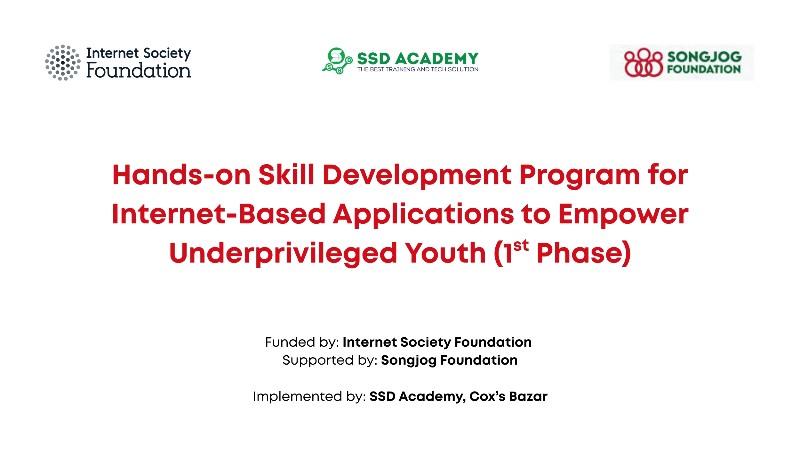
Name of Project: Hands-on Skill Development Program for Internet-Based Applications to Empower Underprivileged Youth (1st Phase)
Project Number: 08
Implemented by : SSD Academy, Cox’s Bazar
Funded by : Internet Society Foundation
Supported by : Songiog Foundation
Location : Cox’s Bazar Sadar and Mohehskhali Cox’s Bazar, Bangladesh
Total Trainees : 120 Participants
1. Executive Summary
The Hands-on Skill Development Program for Internet-Based Applications to Empower Underprivileged Youth (1st Phase) was successfully implemented by SSD Academy, Cox’s Bazar, with financial support from the Internet Society Foundation and technical support from the Songjog Foundation.
The project aimed to empower marginalized and underprivileged youth in Cox’s Bazar through digital skills training, enabling them to participate in the growing digital economy and improve their livelihood opportunities.
A total of 120 trainees (90+30) participated in the program and received hands-on training in Basic Computer Operation, Graphic Design, and Digital Marketing. The training sessions were conducted in Cox’s Bazar Sadar and Moheshkhali, ensuring accessibility for youth from underserved communities.
Through this initiative, participants gained practical knowledge of internet-based applications, freelancing opportunities, digital entrepreneurship, and modern workplace technologies. The project has significantly contributed to reducing digital skill gaps among underprivileged youth while promoting inclusive digital development in the region.
2. Project Background
In the modern digital era, digital literacy and internet-based skills are essential for economic empowerment and employment generation. However, many young people in underprivileged communities in Cox’s Bazar lack access to structured digital skills training and employment-oriented education.
Recognizing this challenge, the Internet Society Foundation launched an initiative to promote digital capacity building among marginalized youth. With support from the Songjog Foundation, the program was implemented locally by SSD Academy, a training institution dedicated to youth development and technology education.
The project aimed to provide hands-on digital training programs that equip young people with market-relevant skills in computer operation, graphic design, and digital marketing. These skills open pathways to online employment, freelancing, entrepreneurship, and remote work opportunities.
3. Project Objectives
General Objective
To empower underprivileged youth in Cox’s Bazar through internet-based skill development training that enhances employability and digital inclusion.
Specific Objectives
To provide practical training in Basic Computer Operation.
To develop professional skills in Graphic Design and Digital Marketing.
To promote digital entrepreneurship and freelancing opportunities.
To improve digital literacy among marginalized youth.
To strengthen the capacity of participants to access online employment opportunities.
4. Project Implementation
Implementing Organization: SSD Academy, Cox’s Bazar
SSD Academy served as the main implementing partner responsible for:
Training design and curriculum development
Trainer recruitment and management
Participant selection and orientation
Monitoring and evaluation
Training delivery and reporting
Funding Partner
Internet Society Foundation
The Internet Society Foundation provided financial support to implement the project and promote internet-based capacity development among youth.
Supporting Organization
Songjog Foundation
Songjog Foundation supported the project through technical guidance, coordination, and capacity development support.
5. Training Trade and Curriculum
The training program focused on three core skill areas designed to meet the demands of the digital economy and online job market.
1. Basic Computer Operation
Participants learned essential computer skills including:
Computer fundamentals
Operating systems
Microsoft Office applications
Internet browsing
Email communication
File management
Online safety and cybersecurity basics
These skills provided the foundation for digital literacy and workplace readiness.
2. Graphic Design
The graphic design training included practical instruction on:
Design fundamentals
Color theory and typography
Adobe Photoshop
Adobe Illustrator
Social media design
Logo design
Banner and promotional design
Participants gained the ability to create professional digital content for businesses and online platforms.
3. Digital Marketing
The digital marketing course covered:
Social media marketing
Facebook page management
Content marketing strategies
Search Engine Optimization (SEO)
Online advertising
Freelancing platforms
Brand promotion techniques
These skills help trainees start online businesses or provide digital marketing services to clients globally.
6. Target Beneficiaries
The project targeted underprivileged youth aged between 18–35 years from Cox’s Bazar district.
Priority was given to:
Unemployed youth
Youth from low-income families
Students who lacked access to digital education
Youth interested in freelancing and online work
Women and marginalized community members
A total of 120 trainees were successfully enrolled and trained under the program.
7. Training Locations
The training activities were conducted in the following locations:
Cox’s Bazar Sadar
The main training center where the majority of sessions were held.
Moheshkhali, Cox’s Bazar
A secondary location where trainees from remote areas received access to the training program.
These locations ensured greater accessibility and inclusion for rural and marginalized communities.
8. Training Methodology
The program adopted a hands-on, practical learning approach.
Training methods included:
Instructor-led sessions
Practical assignments
Group exercises
Project-based learning
Real-life case studies
Online resource exploration
Participants were encouraged to practice real-world digital tasks such as designing graphics, creating marketing campaigns, and managing online platforms.
9. Key Achievements
The project achieved several important outcomes:
120 underprivileged youth trained in digital skills
Increased digital literacy and internet awareness
Participants gained market-relevant technical skills
Many trainees showed interest in freelancing platforms
Increased awareness of online income opportunities
Improved confidence and employability of youth
The training helped bridge the digital divide in Cox’s Bazar communities.
10. Impact of the Project
The project had a significant positive impact on participants and communities.
Economic Empowerment
Participants gained skills that enable them to earn income through freelancing, remote jobs, and digital services.
Digital Inclusion
The program helped reduce the digital skills gap among disadvantaged youth.
Youth Development
Participants developed confidence, creativity, and professional capabilities.
Community Development
The program contributes to the development of a digitally skilled workforce in Cox’s Bazar.
11. Challenges Faced
During the implementation, several challenges were encountered:
Limited access to computers among some trainees
Internet connectivity issues in remote areas
Lack of prior digital knowledge among participants
Transportation challenges for trainees from distant communities
Despite these challenges, the project team successfully ensured the completion of all training activities.
12. Lessons Learned
The project provided valuable insights for future programs:
Hands-on training significantly improves learning outcomes
Local training centers increase participation from rural youth
Continuous mentoring improves skill retention
Digital marketing and graphic design have strong demand among youth
These lessons will help improve future phases of digital skills training programs.
13. Sustainability Plan
To ensure long-term impact, the project encourages:
Continuous practice of learned skills
Engagement with freelancing platforms
Alumni networking among trainees
Collaboration with local businesses
Future advanced training programs
SSD Academy will continue supporting trainees through guidance and mentorship.
14. Conclusion
The Hands-on Skill Development Program for Internet-Based Applications to Empower Underprivileged Youth has successfully achieved its objectives of promoting digital literacy, skill development, and employment opportunities.
Through the support of the Internet Society Foundation and Songjog Foundation, and the implementation by SSD Academy, the project has empowered 120 underprivileged youth in Cox’s Bazar with valuable digital skills.
This initiative represents an important step toward building a digitally skilled and economically empowered youth population, contributing to sustainable development and inclusive growth.
Project Gallery
23 photos