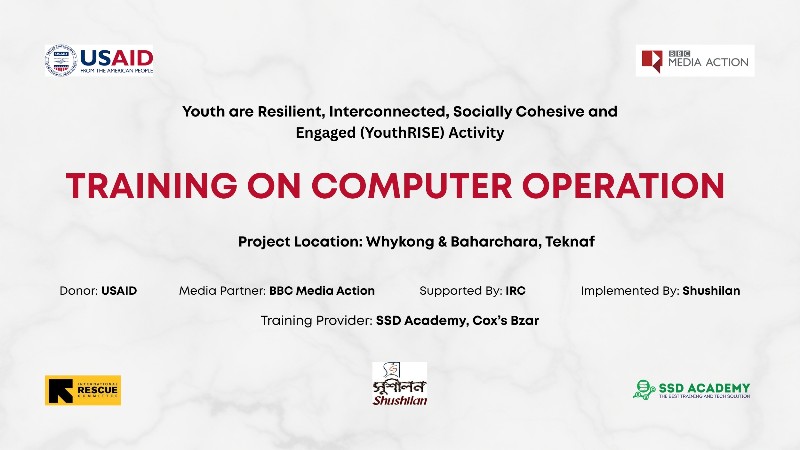
The YouthRISE Activity provided computer office application training to youth in Teknaf, Cox’s Bazar, empowering 40 participants with digital skills, employability knowledge, and practical IT competencies. The project promoted youth resilience, social cohesion, and economic opportunities through vocational skill development.
Implemented by Shushilan with support from USAID, BBC Media Action, and IRC, this project delivered a 72-hour computer training program through SSD Academy, improving digital literacy, employment readiness, and community engagement among youth in Whykong and Baharchara, Cox’s Bazar.
Project Completion Report
Name of Project: USAID-Youth are Resilient, Interconnected, Socially Cohesive and Engaged (YouthRISE) Activity
Training Completion Report (July – September 2023)
Funding Partner: USAID
Media Partner: BBC Media Action
Technical Support: International Rescue Committee (IRC)
Implementing Partner: Shushilan
Training Provider: Step-Up Skill Development (SSD) Academy
Submission Date: September 27, 2023
1. Executive Summary
The Youth are Resilient, Interconnected, Socially Cohesive and Engaged (YouthRISE) Activity is a youth empowerment initiative supported by USAID, implemented by Shushilan, and technically supported by the International Rescue Committee (IRC) with media partnership from BBC Media Action.
The objective of this program was to enhance youth capacity through vocational skill development training, specifically focusing on Computer Office Application training. The training program was delivered by Step-Up Skill Development (SSD) Academy, a nationally recognized technical training institute in Bangladesh.
The project was conducted between July 18, 2023 and September 25, 2023, targeting youth participants from two communities in Teknaf, Cox’s Bazar. The program aimed to provide participants with practical digital skills, employability competencies, and entrepreneurship knowledge, helping them become productive members of society.
A total of 72 participants successfully completed the training program across two training centers. The training included 36 structured sessions, practical computer training, theoretical learning, examinations, and certificate distribution.
The project contributed to:
Youth skill development
Digital literacy improvement
Employment opportunities
Social cohesion
Community empowerment
2. Project Background
The YouthRISE Activity was designed to strengthen youth resilience, promote social engagement, and improve livelihood opportunities through structured skill development training.
Youth in Cox’s Bazar often face limited employment opportunities, lack of vocational training access, and socio-economic challenges. To address these challenges, this project focused on developing technical and digital competencies among youth, particularly through Computer Office Application training.
The training program aimed to equip participants with the skills necessary to operate modern computer applications and utilize digital tools effectively in academic, professional, and entrepreneurial environments.
Through collaborative efforts among international organizations, local implementing partners, and training providers, the project sought to bridge the digital skills gap and empower youth with practical knowledge and employability skills.
3. About Step-Up Skill Development (SSD) Academy
Step-Up Skill Development (SSD) Academy is a modern vocational training institute established in 2023 in Cox’s Bazar, Bangladesh. The academy focuses on practical, demand-driven, and employment-oriented technical education.
SSD Academy is affiliated with the Bangladesh Technical Education Board (BTEB) and follows the National Training and Vocational Qualifications Framework (NTVQF) to ensure standardized and high-quality training delivery.
The institute provides:
IT and computer training
Digital skills development
Software and web development training
Freelancing and entrepreneurship training
Digital marketing programs
Technical skill training in multiple trades
SSD Academy aims to build a skilled workforce capable of contributing to Bangladesh’s digital economy and socio-economic development.
4. Project Information
5. Project Implementation Area
The training program was conducted in two locations in Teknaf, Cox’s Bazar:
1. Whykong Bazar Training Center
Location: Whykong Bazar, Teknaf, Cox’s Bazar
2. Baharchara Training Center
Location: Shamlapur High School, Baharchara, Teknaf, Cox’s Bazar
These areas were selected due to their high demand for youth skill development and digital literacy programs.
6. Training Course Description
The project implemented a Computer Office Application training program designed to provide participants with essential computer skills required for employment and self-employment.
Training Statistics
7. Training Curriculum
The training curriculum followed the Certificate Course on Computer Office Application (Trade Code: 0076) and included both theoretical and practical learning components.
Core Modules
Introduction to Computer and Operating System
Microsoft Word Processing
Microsoft Excel Spreadsheet Analysis
Microsoft PowerPoint Presentation Design
Database Management
Email and Internet Applications
Google Workspace (G-Suite)
Basics of Freelancing
Soft Skills Development
Communicative English
The total course duration was 72 hours, delivered over 12 weeks with 2 hours of training per day and 6 days per week.
8. Training Methodology
The training methodology focused on practical learning and interactive teaching techniques.
Methods included:
Classroom lectures
Computer lab practical sessions
Group assignments
Typing practice
Quizzes and module tests
Monthly assessments
Pre-test and post-test evaluations
Final written, practical, and viva examinations
This approach ensured that participants developed both theoretical understanding and hands-on technical skills.
9. Project Activities
The following key activities were implemented during the project:
Training Implementation
Conducted Training of Trainers (ToT)
Organized 36 structured training sessions
Delivered practical computer training
Provided training materials and modules
Project Management
Established project office near training centers
Conducted regular monitoring visits
Maintained training attendance and performance records
Assessment and Certification
Conducted pre-training assessment
Organized module-based tests
Conducted final examinations
Distributed certificates to successful trainees
10. Project Outputs
The YouthRISE training program achieved several important outputs:
72 hours of structured computer training delivered
40 youth participants successfully trained
Improved digital literacy among youth
Vocational training certificates distributed
Increased awareness of employment opportunities in the digital sector
Participants gained practical skills in:
Office software
Internet communication
Digital documentation
Spreadsheet analysis
Presentation design
11. Project Impact
The project has had a significant positive impact on the participating youth and the surrounding community.
Key Impacts
1. Youth Skill Development
Participants developed professional computer skills necessary for employment.
2. Employment Opportunities
The training increased opportunities for participants in:
Government and private sector jobs
NGOs and development organizations
Freelancing and online work
Self-employment opportunities
3. Social Empowerment
The program strengthened youth engagement and promoted social cohesion within communities.
4. Community Development
Participants are now able to contribute to community development through digital knowledge and improved professional skills.
12. Beneficiary Participation and Accountability
The YouthRISE project followed a community-driven approach, ensuring that beneficiaries actively participated in all activities.
Key engagement strategies included:
Orientation sessions
Regular feedback collection
Group discussions
Community consultations
Participant monitoring
These mechanisms ensured transparency, accountability, and participant satisfaction.
13. Community Feedback
Community members and participants expressed positive feedback regarding the training program.
Feedback highlights included:
High satisfaction with training quality
Appreciation for practical computer training
Demand for advanced IT courses
Interest in freelancing and digital employment
Participants emphasized that the program enhanced their confidence and digital capabilities.
14. Risk Identification and Management
Throughout the project implementation period, SSD Academy actively monitored potential risks.
Risk Management Strategies
Regular monitoring visits by project coordinators
Monthly feedback sessions with trainees
Supervision by Shushilan project team
Context analysis and adaptive planning
15. Challenges
Despite the successful implementation, several challenges were identified:
Limited training duration compared to BTEB curriculum
Limited access to computers in some locations
Participants with varying digital literacy levels
However, trainers overcame these challenges through additional practice sessions and personalized guidance.
16. Way Forward
Based on project outcomes and community demand, the following recommendations are proposed:
Expand digital skills training programs
Introduce advanced IT courses
Provide freelancing and entrepreneurship training
Establish permanent training centers in remote areas
Strengthen partnerships with employers
17. Conclusion
The YouthRISE Activity Training Program successfully achieved its objectives of empowering youth through vocational and digital skill development.
The collaboration between USAID, BBC Media Action, IRC, Shushilan, and SSD Academy enabled the effective implementation of this initiative.
Through structured training, practical learning, and community engagement, the project has contributed to:
Youth empowerment
Digital literacy development
Social cohesion
Economic opportunity creation
Prepared By
Ziabul Haque (ZIA)
Chief Executive Officer (CEO)
Step-Up Skill Development Academy
Date: 27 September 2023