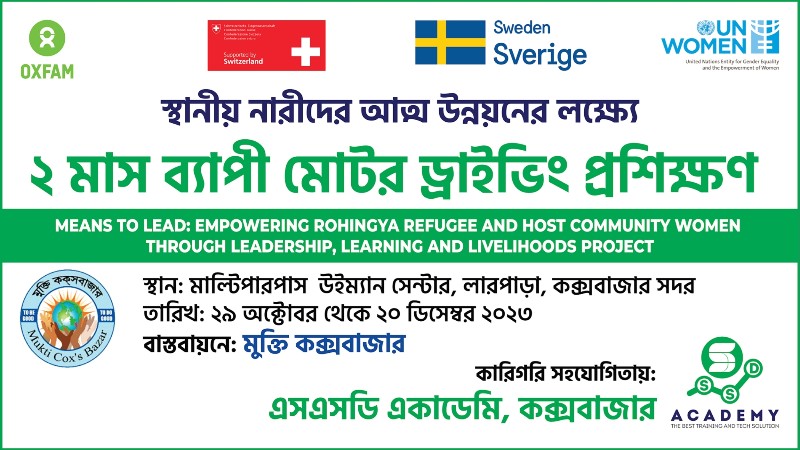
Motor Driving Training under the MEANS TO LEAD project empowered Rohingya refugee and host community women in Cox’s Bazar with professional driving skills, promoting economic independence and leadership through support from OXFAM, UN Women, Switzerland, and Sweden.
SSD Academy delivered motor driving training for 18 women under the MEANS TO LEAD project implemented by Mukti Cox’s Bazar. Funded by OXFAM and UN Women and supported by Switzerland and Sweden, the initiative strengthens women’s livelihoods, skills, and leadership in Cox’s Bazar communities. 🚗
Project Completion Report
MEANS TO LEAD: Empowering Rohingya Refugee and Host Community Women Through Leadership and Livelihoods Project
Implemented Motor Driving Training Program for Women in Cox’s Bazar
Funded by: OXFAM and UN Women
Supported by: Switzerland and Sweden
Implemented by: Mukti Cox’s Bazar
Training Provider: SSD Academy (Step-Up Skill Development Academy)
1. Project Overview
The “MEANS TO LEAD: Empowering Rohingya Refugee and Host Community Women Through Leadership and Livelihoods Project” is a transformative initiative designed to strengthen the economic empowerment, leadership capacity, and livelihood opportunities of women from both Rohingya refugee communities and host communities in Cox’s Bazar, Bangladesh.
The project focuses on enhancing women’s independence by providing practical vocational skills training, specifically motor driving training, which opens pathways for sustainable employment and entrepreneurship.
This initiative was funded by OXFAM and UN Women, with additional support from Switzerland and Sweden, and implemented by Mukti Cox’s Bazar. The vocational training component was delivered by SSD Academy (Step-Up Skill Development Academy), a leading training provider specializing in professional skill development and livelihood training programs.
The project reflects a strong commitment to gender equality, women’s empowerment, and inclusive economic development, particularly in humanitarian and refugee contexts
2. Project Objectives
The main objective of this project was to empower women socially and economically by providing them with market-relevant vocational skills that can improve their employment prospects.
Specific objectives include:
2.1 Economic Empowerment of Women
Provide practical vocational training that allows women to gain income-generating opportunities through professional motor driving.
2.2 Leadership Development
Build confidence and leadership skills among women from refugee and host communities, enabling them to participate more actively in their communities.
2.3 Skill Development
Equip trainees with technical driving skills, road safety knowledge, vehicle maintenance basics, and responsible driving practices.
2.4 Social Inclusion
Promote collaboration and mutual understanding between Rohingya refugee women and host community women through joint training programs.
2.5 Sustainable Livelihood Opportunities
Create long-term livelihood opportunities by enabling women to work as professional drivers, ride-sharing service providers, delivery drivers, or small business owners.
3. Project Implementing Partners
The successful implementation of the project was made possible through collaboration between international development organizations, local NGOs, and training institutions.
Funding Organizations
OXFAM
UN Women
Supporting Countries
Switzerland
Sweden
Implementing Organization
Mukti Cox’s Bazar
Training Provider
SSD Academy (Step-Up Skill Development Academy)
SSD Academy played a crucial role in delivering high-quality vocational training and practical driving education, ensuring participants received both theoretical knowledge and hands-on experience.
4. Training Program Details
Training Trade
Motor Driving
Total Number of Trainees
18 Participants
16 Women Trainees
2 Additional Participants (support/extended trainees)
Training Location
Cox’s Bazar Sadar
Holidya Palang
These locations were strategically selected to ensure accessibility for both refugee and host community women.
5. Role of SSD Academy
SSD Academy (Step-Up Skill Development Academy) served as the official training provider, responsible for designing and delivering a structured and professional training curriculum.
Key responsibilities of SSD Academy included:
Designing a professional motor driving training curriculum
Conducting theoretical and practical driving lessons
Providing road safety education
Teaching basic vehicle maintenance
Monitoring trainees’ progress and performance
Conducting final assessments and certification
SSD Academy ensured that the training program maintained high standards of vocational education and practical skill development.
6. Training Curriculum
The motor driving training program included a comprehensive curriculum covering both technical skills and safety awareness.
Key Training Modules
6.1 Basic Driving Skills
Vehicle controls and functions
Steering techniques
Gear shifting
Acceleration and braking
6.2 Traffic Rules and Road Safety
Bangladesh traffic laws
Road safety practices
Defensive driving techniques
Hazard awareness
6.3 Practical Driving Experience
On-road driving practice
Urban driving conditions
Parking techniques
Emergency handling
6.4 Vehicle Maintenance
Basic car maintenance
Checking engine oil and fluids
Tire maintenance
Basic troubleshooting
6.5 Professional Conduct
Customer service skills
Professional driver responsibilities
Communication and behavior
7. Training Methodology
SSD Academy adopted an interactive and hands-on training approach to ensure trainees gained both confidence and competence.
Training methods included:
Classroom-based theoretical lessons
Practical driving sessions
Demonstration-based learning
Group discussions and workshops
Road safety simulations
Continuous evaluation and feedback
This blended approach helped trainees build confidence, technical skills, and leadership capabilities.
8. Participant Profile
The trainees consisted of women from:
Rohingya refugee communities
Local host communities in Cox’s Bazar
Most participants had limited prior access to vocational training opportunities, making this program an important stepping stone for their personal and economic development.
Many trainees joined the program with strong motivation to:
Gain financial independence
Support their families
Break traditional gender barriers
Develop new career opportunities
9. Key Achievements
The project successfully achieved several important outcomes.
9.1 Women Empowerment
Women participants gained confidence, independence, and new professional skills.
9.2 Skill Acquisition
All trainees successfully learned motor driving skills and road safety knowledge.
9.3 Increased Employment Opportunities
Participants now have opportunities to pursue employment as:
Professional drivers
Ride-sharing drivers
Delivery drivers
Transport service providers
9.4 Community Impact
The project helped challenge traditional gender roles by demonstrating that women can succeed in the transportation sector.
9.5 Strengthened Social Cohesion
Joint training created positive interaction between Rohingya refugees and host community members.
10. Challenges Faced
While the project achieved its goals, several challenges were encountered:
Cultural barriers regarding women driving
Limited prior driving experience among trainees
Infrastructure limitations in training areas
Safety concerns and mobility restrictions
These challenges were addressed through community engagement, supportive training environments, and mentorship.
11. Lessons Learned
Key lessons from the project include:
Women show high motivation and adaptability when given access to skill development opportunities.
Practical vocational training can significantly improve confidence and employability.
Community awareness programs help reduce social barriers to women’s participation.
12. Sustainability and Future Opportunities
To ensure sustainability, the project encourages trainees to:
Apply for driving licenses
Seek employment in the transportation sector
Start small transportation services
Participate in future advanced training programs
SSD Academy plans to continue supporting women’s skill development and livelihood training initiatives in Cox’s Bazar and across Bangladesh.
13. Conclusion
The MEANS TO LEAD Project has successfully empowered women from Rohingya refugee and host communities through motor driving vocational training.
Through collaboration between OXFAM, UN Women, Mukti Cox’s Bazar, and SSD Academy, the project created meaningful opportunities for women to gain professional skills, financial independence, and leadership capacity.
The initiative demonstrates how targeted vocational training programs can transform lives, strengthen communities, and promote gender equality in challenging humanitarian contexts.
SSD Academy remains committed to supporting inclusive skill development and sustainable livelihood opportunities for marginalized communities across Bangladesh.