A skills development initiative empowering women and youth in Cox’s Bazar through vocational and pre-vocational training in graphic design, computer operation, and batik printing to enhance employability and economic opportunities.
The ISEC project trained 160 participants in Cox’s Bazar through NTVQF-based vocational programs, improving digital, technical, and entrepreneurial skills to support sustainable livelihoods and inclusive economic growth.
Project Completion Report
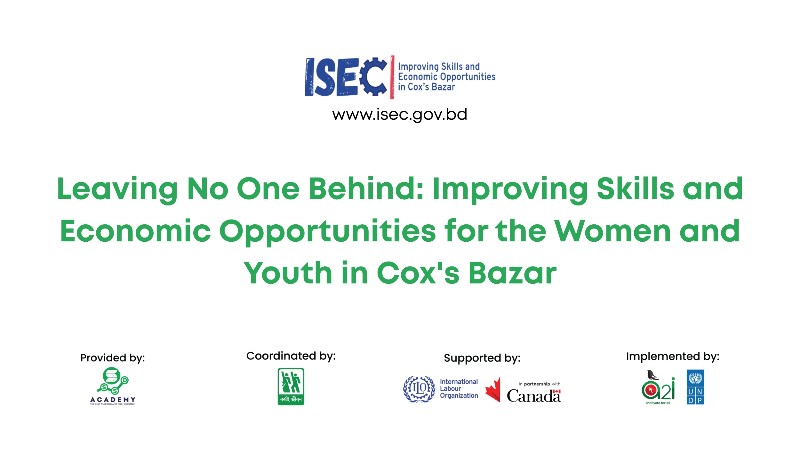
Leaving No One Behind: Improving Skills and Economic Opportunities for Women and Youth in Cox’s Bazar, Bangladesh (ISEC)
Funded by: Global Affairs Canada
Implemented by: Aspire to Innovate (a2i) & United Nations Development Programme (UNDP)
Supported by: Department of Youth Development (DYD), ILO, BRAC
1. Project Overview
The “Leaving No One Behind: Improving Skills and Economic Opportunities for Women and Youth in Cox’s Bazar, Bangladesh (ISEC)” project was designed to enhance the livelihood opportunities, employability skills, and economic resilience of marginalized women and youth in Cox’s Bazar district. The initiative aimed to address unemployment and limited access to technical education in vulnerable communities by providing competency-based vocational and pre-vocational training aligned with the National Technical and Vocational Qualifications Framework (NTVQF).
Cox’s Bazar, particularly areas such as Moheshkhali, Ramu, and Cox’s Bazar Sadar, faces challenges related to limited employment opportunities, poverty, and restricted access to formal skill development programs. Through this project, participants were equipped with market-relevant technical skills, enabling them to pursue self-employment, freelancing, or formal job opportunities.
The project emphasized inclusive training, ensuring that women, youth, and marginalized groups had equitable access to quality skill development opportunities.
2. Funding and Partnerships
This project was implemented through a collaborative partnership among national and international organizations working toward sustainable development and economic empowerment.
Coordinated By:
Department of Youth Development (DYD)
Funded by
Government of Global Affairs Canada
Government of Netherlands
Supported by
United Nations Development Programme (UNDP)
Food and Agriculture Organization (FAO)
Implemented by
BRAC
a2i (Aspire to Innovate)
International Labour Organization (ILO)
Training Provider
SSD Academy (Step-Up Skill Development Academy)
These partners played a critical role in ensuring that the training programs aligned with international standards, national skill development frameworks, and local market demands.
3. Project Objectives
The primary objectives of the ISEC project were to:
3.1 Enhance Employability Skills
Provide participants with practical and industry-relevant vocational skills in fields with strong employment potential.
3.2 Promote Economic Empowerment
Enable women and youth to generate income through entrepreneurship, freelancing, or employment.
3.3 Increase Access to Skill Development
Create opportunities for marginalized communities to access quality training programs aligned with NTVQF standards.
3.4 Strengthen Local Economic Participation
Support community development by preparing a skilled workforce capable of contributing to local industries and digital economy sectors.
4. Training Program Overview
The project implemented both Pre-Vocational Training and Vocational Training programs designed to develop foundational and advanced technical skills.
The training programs were delivered over a three-month period, consisting of 72 classes with each session lasting 5 hours.
The courses offered included:
Graphic Design (NTVQF Level-2)
Basic Computer Operation (NTVQF Level-1)
Block Batik and Screen Printing (NTVQF Pre-Vocational)
These courses were selected based on local market demand and potential income-generating opportunities.
5. Pre-Vocational Training Implementation
The pre-vocational training program targeted youth from educational institutions, particularly madrasahs, to introduce them to technical and digital skills at an early stage.
Training Venues and Details
5.1 Umm Habiba (RA) Islamia Balika Madrasa – Moheshkhali
Location: Munsir Dale, Bara Maheshkhali, Moheshkhali, Cox’s Bazar
Course Offered Block Batik and Screen Printing (NTVQF Pre-Voc-01)
Training Duration: January 10, 2024 – April 17, 2024 (3 Months)
Training Statistics
Female Learners: 40
Male Learners: 0
Persons with Disabilities (PWD): Not reported
Total Classes: 72
Completed Classes: 72
Class Duration: 5 hours per session
Assessment Result:
100% of participants were assessed as Competent, demonstrating strong practical skills in batik design and screen printing techniques.
5.2 Al-Jamia Arabia Islamia Madrasa – Moheshkhali
Location: Gorakghata, Maheshkhali Municipality, Cox’s Bazar
Course Offered: Basic Computer Operation (NTVQF Level-01)
Training Duration: January 10, 2024 – April 17, 2024 (3 Months)
Training Statistics
Male Learners: 40
Female Learners: 0
Total Classes: 72
Completed Classes: 72
Class Duration: 5 hours per session
Assessment Result: 100% Competent
Participants gained essential computer skills including:
Microsoft Office applications
Internet browsing and digital communication
Basic data entry and documentation
Introduction to digital literacy
5.3 Al Ihsan Islamic Center – Ramu
Location: East Island Fatekhanrkul, Ramu, Cox’s Bazar
Course Offered: Basic Computer Operation (NTVQF Level-01)
Training Duration: February 05, 2024 – May 12, 2024 (3 Months)
Training Statistics
Male Learners: 40
Female Learners: 0
Total Classes: 72
Completed Classes: 72
Class Duration: 5 hours
Assessment Result: 100% Competent
Participants developed strong foundational digital literacy and computer operation skills, preparing them for further vocational education and employment opportunities.
6. Vocational Training Implementation
The vocational training program focused on advanced technical skill development that could directly support income generation and employment.
Training Provider
SSD Academy, Cox’s Bazar Branch
Address: 622 Raiyan Villa (2nd Floor), Main Road, Kalur Dokan, Cox’s Bazar – 4700
Course: Graphic Design (NTVQF Level-2)
Training Duration:
December 2, 2023 – February 28, 2024
Training Statistics
Male Participants: 27
Female Participants: 13
Total Participants: 40
Training Structure
Total Classes: 72
Completed Classes: 72
Duration per Class: 5 hours
Assessment Result: 90% Competent
Participants learned practical graphic design skills including:
Adobe Photoshop
Adobe Illustrator
Layout and visual composition
Logo design and branding
Social media content design
Freelancing marketplace preparation
These skills prepared trainees for freelance graphic design work, digital marketing support roles, and creative entrepreneurship.
7. Training Outcomes and Achievements
The project achieved significant success in delivering skill development programs and empowering participants.
Total Participants
Gender Distribution
Male Participants: 107
Female Participants: 53
Training Completion
Total Classes Conducted: 72 per batch
Class Duration: 5 hours per session
Training Duration: 3 months
Competency Results
Pre-Vocational Programs: 100% Competent
Vocational Program: 90% Competent
8. Impact of the Project
The ISEC project contributed to socioeconomic empowerment and skill development in Cox’s Bazar.
Key impacts include:
8.1 Increased Digital Literacy
Participants developed essential computer and digital communication skills necessary for the modern workforce.
8.2 Economic Empowerment
Trainees acquired practical skills enabling them to pursue self-employment, freelancing, or formal jobs.
8.3 Women Empowerment
Female participants gained access to skill development opportunities, promoting gender equality and financial independence.
8.4 Entrepreneurship Opportunities
Skills such as graphic design and batik printing allow participants to start small businesses or home-based production activities.
9. Challenges Faced During Implementation
While the project achieved its objectives, several challenges were encountered:
Limited infrastructure in remote areas
Transportation barriers for trainees
Internet connectivity issues affecting digital training
Social barriers limiting female participation in some locations
These challenges were addressed through community engagement, flexible training schedules, and local partnerships.
10. Lessons Learned
Several key lessons emerged from the implementation:
Community-based training centers improve accessibility.
Female-focused training environments encourage participation.
Practical skill-based training significantly increases competency outcomes.
Collaboration with local institutions such as madrasahs strengthens community engagement.
11. Sustainability and Future Opportunities
To ensure long-term impact, the project encourages:
Continued vocational training programs in Cox’s Bazar
Support for graduates to access freelancing platforms and entrepreneurship opportunities
Linkages with local industries and digital job markets
Follow-up mentorship for trainees
These efforts will contribute to sustainable economic growth and poverty reduction in the region.
12. Conclusion
The ISEC project successfully empowered 160 women and youth in Cox’s Bazar through structured vocational and pre-vocational training programs. With strong support from international donors, UN agencies, and implementing partners, the project significantly enhanced participants’ technical skills, employability, and economic prospects.
The high competency rates achieved during training demonstrate the effectiveness of competency-based vocational education aligned with NTVQF standards.
By investing in skills development, the project has contributed to building a more resilient, skilled, and economically active community in Cox’s Bazar, Bangladesh.