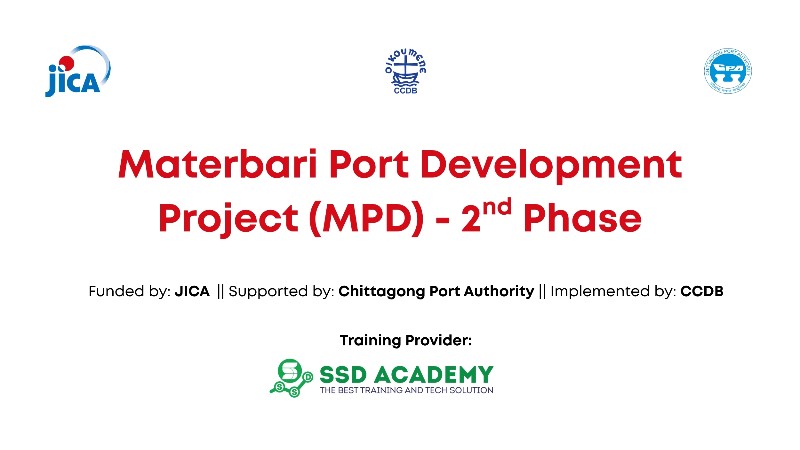
SSD Academy successfully completed the Materbari Port Development Project (MPD – 2nd Phase) training program in Moheshkhali, Cox’s Bazar. Funded by JICA and supported by Chittagong Port Authority, the project trained 212 youth in technical trades to enhance employability and support local infrastructure development.
Under the Materbari Port Development Project (MPD – 2nd Phase), SSD Academy delivered vocational training in EIM, welding, masonry, automobile servicing, and mobile phone servicing for 212 trainees in Moheshkhali, Cox’s Bazar, empowering local youth with practical skills for employment and self-employment opportunities.
Project Completion Report
Materbari Port Development Project (MPD – 2nd Phase)
SSD Academy – Step-Up Skill Development Academy
1. Project Overview
The Materbari Port Development Project (MPD – 2nd Phase) is a strategic infrastructure development initiative aimed at strengthening Bangladesh’s maritime and logistics capabilities. Alongside the physical development of the port, the project emphasized human resource development through technical and vocational skills training to ensure that local communities benefit from emerging employment opportunities.
To achieve this goal, SSD Academy (Step-Up Skill Development Academy) was selected as the training provider under the project. The training program focused on developing market-oriented technical skills among local youth in Moheshkhali, Cox’s Bazar, equipping them with competencies required in construction, electrical, automotive, and technology-related sectors.
The project was funded by JICA (Japan International Cooperation Agency), supported by the Chittagong Port Authority, and implemented by CCDB (Christian Commission for Development in Bangladesh).
Through this initiative, SSD Academy successfully delivered industry-relevant technical training to 212 trainees, enhancing employability, promoting sustainable livelihoods, and contributing to the socio-economic development of the Materbari region.
2. Project Objectives
The primary objectives of the Materbari Port Development Project Training Program were:
2.1 Develop Skilled Workforce
To develop a pool of technically skilled workers capable of supporting ongoing and future infrastructure projects related to the Materbari deep sea port development.
2.2 Enhance Employment Opportunities
To provide job-ready vocational training that increases employment prospects for local youth in sectors such as construction, electrical services, automotive maintenance, and mobile servicing.
2.3 Promote Local Economic Development
To empower residents of BodorKhali, Moheshkhali, Cox’s Bazar by equipping them with practical skills that lead to income generation and self-employment opportunities.
2.4 Support Inclusive Development
To ensure that local communities benefit directly from large-scale development projects by providing access to structured skills training.
3. Project Stakeholders
The successful implementation of the Materbari training program involved collaboration between several key stakeholders.
Funding Agency
Japan International Cooperation Agency (JICA)
JICA provided financial support for the training program as part of its commitment to sustainable infrastructure development and human resource capacity building in Bangladesh.
Supporting Organization
Chittagong Port Authority (CPA)
CPA provided institutional support and oversight, ensuring the training aligned with the long-term workforce requirements of the Materbari port development initiative.
Implementing Organization
CCDB (Christian Commission for Development in Bangladesh)
CCDB coordinated project execution, community engagement, and program monitoring.
Training Provider
SSD Academy (Step-Up Skill Development Academy)
SSD Academy was responsible for designing and delivering technical training, conducting assessments, and preparing trainees for employment.
4. Training Location
The training program was conducted in:
BodorKhali, Moheshkhali, Cox’s Bazar, Bangladesh
Moheshkhali is strategically important due to its proximity to the Materbari Deep Sea Port Development Project, making it an ideal location for building a skilled workforce that can support local industrial and infrastructure activities.
5. Training Programs Conducted
SSD Academy conducted six market-driven technical training programs designed to meet local labor market demand.
5.1 EIM – Electrical Installation and Maintenance
The Electrical Installation and Maintenance (EIM) training program focused on developing practical skills in electrical systems used in residential, commercial, and industrial settings.
Key Learning Areas
Basic electrical theory
Wiring systems and electrical circuits
Installation of electrical equipment
Electrical safety practices
Maintenance and troubleshooting of electrical systems
This training prepared participants for employment as electricians, electrical technicians, and maintenance assistants.
5.2 Welding Training
The Welding training program equipped trainees with hands-on skills required in construction, manufacturing, and industrial sectors.
Training Components
Welding safety procedures
Arc welding techniques
Metal cutting and shaping
Equipment handling
Quality inspection and finishing
Welding skills are highly demanded in construction projects, shipbuilding, and infrastructure development.
5.3 Masonry Training
The Mason training program focused on building construction skills relevant to infrastructure and housing projects.
Training Topics
Brick laying and block work
Cement mortar preparation
Plastering techniques
Structural alignment and leveling
Construction site safety
Graduates can work as construction masons, helpers, or building technicians.
5.4 Automobile Servicing Training
The Automobile servicing training program aimed to build skills in vehicle maintenance and repair.
Skills Developed
Basic automotive systems
Engine maintenance
Brake system servicing
Electrical systems in vehicles
Troubleshooting mechanical issues
This training supports employment in automobile workshops, garages, and transport companies.
5.5 MPS – Mobile Phone Servicing
The Mobile Phone Servicing (MPS) training program focused on mobile device maintenance and repair, an increasingly important skill in the digital economy.
Course Content
Mobile hardware components
Fault diagnosis
Software troubleshooting
Mobile phone repair techniques
Customer service skills
Graduates can start mobile servicing businesses or work in mobile repair centers.
6. Training Participants
The project successfully trained 212 trainees from local communities.
Trade-wise Trainee Distribution
The trainees were primarily local youth seeking employment and technical skills training opportunities.
7. Training Methodology
SSD Academy adopted a competency-based training approach to ensure practical skill development.
Key Training Methods
Classroom theoretical sessions
Hands-on practical training
Demonstrations and simulations
Practical assignments
Continuous assessment
This approach ensured trainees gained real-world practical experience alongside theoretical knowledge.
8. Project Achievements
The Materbari training program achieved several significant outcomes.
Skilled Workforce Development
A total of 212 individuals gained technical skills relevant to construction, electrical services, automotive repair, and mobile technology.
Employment Readiness
Participants developed job-ready competencies that can support employment in local infrastructure and service sectors.
Community Empowerment
The project strengthened economic opportunities for youth in Moheshkhali and surrounding areas.
Support for Infrastructure Development
By training local workers, the program contributed to the availability of skilled manpower for Materbari port-related projects.
9. Impact on Local Communities
The project had a positive socio-economic impact in several ways:
Increased employment opportunities for youth
Promoted self-employment through technical skills
Reduced skill gaps in the local labor market
Encouraged community participation in development initiatives
Many trainees can now pursue careers in construction, electrical work, mobile servicing, and automotive maintenance.
10. Challenges Faced
Despite successful implementation, several challenges were encountered:
Limited technical exposure among trainees prior to training
Logistical challenges due to the remote island location
Need for additional advanced training opportunities
However, SSD Academy addressed these challenges through adaptive training strategies and community engagement.
11. Lessons Learned
Key lessons from the project include:
Local youth are highly motivated when provided access to structured training.
Hands-on practical training significantly improves learning outcomes.
Community-based training programs increase participation and impact.
These insights will help improve future vocational training programs in Bangladesh.
12. Conclusion
The Materbari Port Development Project Training Program represents a successful collaboration between JICA, Chittagong Port Authority, CCDB, and SSD Academy to promote sustainable development through skills training.
By training 212 individuals in six technical trades, SSD Academy contributed to building a skilled workforce capable of supporting Bangladesh’s growing infrastructure and industrial sectors.
The program not only enhanced employability but also empowered local communities by creating pathways toward economic independence and professional growth.
SSD Academy remains committed to delivering high-quality vocational training programs that support national development and empower future generations.