A skills development project empowering youth from Rohingya camps and host communities in Cox’s Bazar through vocational training in gas stove repairing, solar panel maintenance, tailoring, handicrafts, and mobile servicing to promote employment and community resilience.
SSD Academy successfully implemented vocational skills training for 51 youth in Camp-21 and Camp-24, Teknaf, Cox’s Bazar. Supported by German Cooperation and funded by Plan International Bangladesh, the project built practical skills to improve livelihoods and empower youth as agents of change.
Project Completion Report
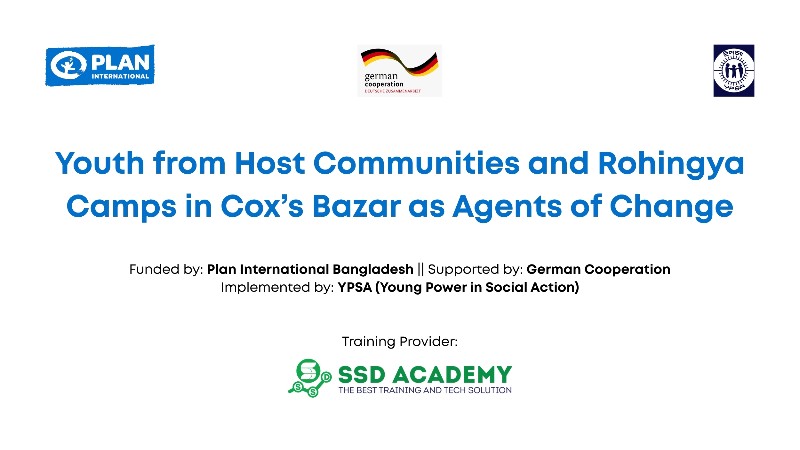
Youth from Host Communities and Rohingya Camps in Cox’s Bazar as Agents of Change
Funded By: Plan International Bangladesh
Supported By: German Cooperation
Implemented By: YPSA (Young Power in Social Action)
Training Provider: SSD Academy, Cox’s Bazar
Project Overview
SSD Academy successfully completed a transformative skills development initiative titled “Youth from Host Communities and Rohingya Camps in Cox’s Bazar as Agents of Change.” The project aimed to empower youth through technical and vocational skills training, enabling them to gain sustainable livelihood opportunities and contribute positively to their communities.
The project was funded by Plan International Bangladesh, supported by German Cooperation, and implemented by YPSA (Young Power in Social Action). SSD Academy served as the training provider, delivering industry-relevant vocational training programs designed to equip participants with practical and marketable skills.
The program was conducted in Camp-24 and Camp-21 in Teknaf, Cox’s Bazar, targeting youth from both host communities and Rohingya refugee camps. Through this initiative, participants received hands-on training in several high-demand technical trades that can help them pursue employment or self-employment.
Project Objectives
The main objective of this project was to strengthen youth capacity and promote economic empowerment among young people living in Cox’s Bazar refugee and host communities.
Specific objectives included:
Providing market-relevant vocational training to unemployed youth
Promoting livelihood opportunities through technical skills development
Supporting economic resilience among Rohingya refugees and host communities
Enhancing participants' ability to become agents of positive social change
Reducing unemployment by creating opportunities for self-employment and entrepreneurship
Through structured training sessions, mentorship, and practical learning, participants gained the skills and confidence required to participate in local economic activities.
Project Stakeholders
The success of the project was made possible through the collaboration of multiple organizations working toward youth empowerment and community development.
Funded By: Plan International Bangladesh
Supported By: German Cooperation
Implemented By: YPSA (Young Power in Social Action)
Training Provider: SSD Academy, Cox’s Bazar
SSD Academy played a crucial role in delivering high-quality technical training, practical workshops, and professional skill-building sessions throughout the project period.
Project Location
The training activities were conducted in the Teknaf region of Cox’s Bazar, which hosts a large population of Rohingya refugees and vulnerable host communities.
Training Locations:
Rohingya Camp-24
Rohingya Camp-21
Teknaf, Cox’s Bazar
These locations were strategically selected to ensure maximum accessibility for both refugee and host community youth, helping reduce barriers to skills training and employment opportunities.
Training Programs and Skills Development
The project offered a variety of technical and vocational training programs designed to meet the demands of local markets and promote sustainable income generation.
1. Gas Stove Repairing Training
Participants received comprehensive training in gas stove repairing and maintenance, including:
Understanding gas stove components
Troubleshooting and repairing common faults
Safety practices for gas appliances
Practical repair techniques
This training enables participants to start small repair services or work with appliance service centers, creating local employment opportunities.
2. Solar Panel Maintenance Training
With the growing importance of renewable energy, trainees learned essential skills in solar panel installation and maintenance, including:
Basic solar energy systems
Solar panel cleaning and troubleshooting
Battery maintenance
System safety and operational efficiency
This trade opens doors to employment in the renewable energy sector, which is expanding rapidly in Bangladesh.
3. Tailoring and Handicraft Training
The tailoring and handicraft training program provided participants with creative and practical skills such as:
Sewing techniques and machine operation
Garment design and pattern cutting
Fabric handling and finishing
Handmade handicraft production
This training supports home-based businesses and micro-enterprises, particularly beneficial for women and youth seeking flexible income opportunities.
4. Mobile Servicing Training
Mobile phone repair is a highly demanded skill in modern communities. Participants learned:
Mobile hardware basics
Software troubleshooting
Screen replacement and component repair
Diagnostic techniques
Graduates of this program can establish mobile servicing shops or work in electronics repair businesses, generating steady income.
Total Number of Trainees
The project successfully trained 51 youth participants across different trades.
Training Distribution:
Gas Stove Repairing – 10 trainees
Solar Panel Maintenance – 20 trainees
Tailoring & Handicraft – 11 trainees
Mobile Servicing & Handicraft – 10 trainees
Total Trainees: 51 participants
These trainees included individuals from both Rohingya refugee camps and surrounding host communities, promoting social cohesion and shared economic development.
Training Methodology
SSD Academy adopted a practical, hands-on training approach to ensure effective skill development.
Key training methods included:
Classroom-based theoretical sessions
Hands-on practical workshops
Demonstrations and real-life problem solving
Tool usage and equipment training
Mentoring and technical guidance
This approach helped trainees gain real-world experience, increasing their confidence and job readiness.
Project Impact and Outcomes
The project has made a significant impact on youth empowerment and livelihood development in Cox’s Bazar.
Key Achievements
✔ Successfully trained 51 youth participants
✔ Developed market-relevant technical skills
✔ Increased employment and self-employment opportunities
✔ Promoted social integration between Rohingya and host communities
✔ Strengthened community resilience and economic stability
Participants are now better prepared to start small businesses, find employment, or provide technical services in their communities.
Role of SSD Academy
SSD Academy played a vital role in ensuring the success of the project by providing:
Professional vocational training programs
Experienced and certified trainers
Practical workshops and skill demonstrations
Technical tools and learning materials
Continuous guidance and mentoring for trainees
Through this initiative, SSD Academy continues to demonstrate its commitment to skills development, youth empowerment, and sustainable community development in Bangladesh.
Conclusion
The completion of the project “Youth from Host Communities and Rohingya Camps in Cox’s Bazar as Agents of Change” marks an important milestone in promoting technical education and livelihood development among vulnerable youth.
By equipping young people with practical vocational skills such as solar panel maintenance, gas stove repairing, tailoring, handicrafts, and mobile servicing, the project has empowered participants to become productive members of society and agents of positive change in their communities.
SSD Academy remains committed to supporting skills development initiatives that improve employment opportunities and strengthen economic resilience in Bangladesh.
Project Gallery
13 photos